
How to Authenticate CHANEL Jewellery: What to Look For
CHANEL jewellery has long been celebrated for its distinctive designs, exceptional attention to detail and timeless appeal. From iconic CC logo earrings and statement necklaces to vintage brooches, bracelets and intricate gold-tone creations, CHANEL jewellery remains highly sought after by collectors and luxury enthusiasts worldwide.
However, the popularity of CHANEL has also made its jewellery a frequent target for counterfeit production. With replicas becoming increasingly sophisticated, distinguishing an authentic piece from an imitation is not always straightforward.
Whether you are considering purchasing a pre-loved CHANEL necklace, investing in a vintage brooch or adding a pair of signature earrings to your collection, understanding the key characteristics of authentic CHANEL jewellery is essential.
At Bijoux Heaven, we believe that knowledge and careful examination are fundamental to luxury resale. In this guide, we explore the important details to consider when assessing the authenticity of CHANEL jewellery.
1. Examine the CHANEL Hallmarks and Stamps
One of the first areas to examine when authenticating CHANEL jewellery is the manufacturer's marking.
Depending on the design, collection and period of production, authentic CHANEL jewellery may feature markings such as:
-
CHANEL
-
CHANEL MADE IN FRANCE
-
CHANEL MADE IN ITALY
-
CHANEL with a copyright symbol
-
Collection-specific or seasonal markings.
These inscriptions may appear on the reverse of earrings, necklace clasps, bracelet closures, brooch fittings or discreet areas of the jewellery.
What should you look for?
Pay close attention to the quality and consistency of the engraving. Authentic markings should generally display clean execution, appropriate proportions and a finish consistent with the individual piece.
Examine:
-
Letter spacing and alignment.
-
Font style and proportions.
-
Engraving depth and clarity.
-
Positioning of the manufacturer's marking.
-
Consistency between the marking and the construction of the jewellery.
Poorly defined lettering, irregular spacing or inconsistent engraving may warrant further investigation.
It is important to understand that CHANEL markings have changed over the decades. Their appearance and positioning can vary considerably between collections and production periods. Therefore, there is no single hallmark that applies universally to all authentic CHANEL jewellery.
2. Understand Vintage CHANEL Jewellery Date Plates
Certain vintage CHANEL jewellery pieces feature distinctive date plates or collection markings.
These markings can provide useful information when assessing a piece, particularly when considering its production period and design history.
Some vintage designs feature oval or circular plates, often positioned on the reverse of necklaces, brooches and bracelets.
Depending on the period, these may incorporate:
-
CHANEL branding.
-
Copyright symbols.
-
Collection or season references.
-
Year-related identifiers.
-
Made in France or Made in Italy inscriptions.
Why are these important?
The markings should be consistent with the design, construction and apparent production period of the jewellery.
However, the presence of a date plate alone does not establish authenticity. Counterfeit manufacturers can reproduce markings, and not every genuine CHANEL jewellery piece features a date plate.
An authentication assessment should therefore consider the entire piece rather than relying on one identifying feature.
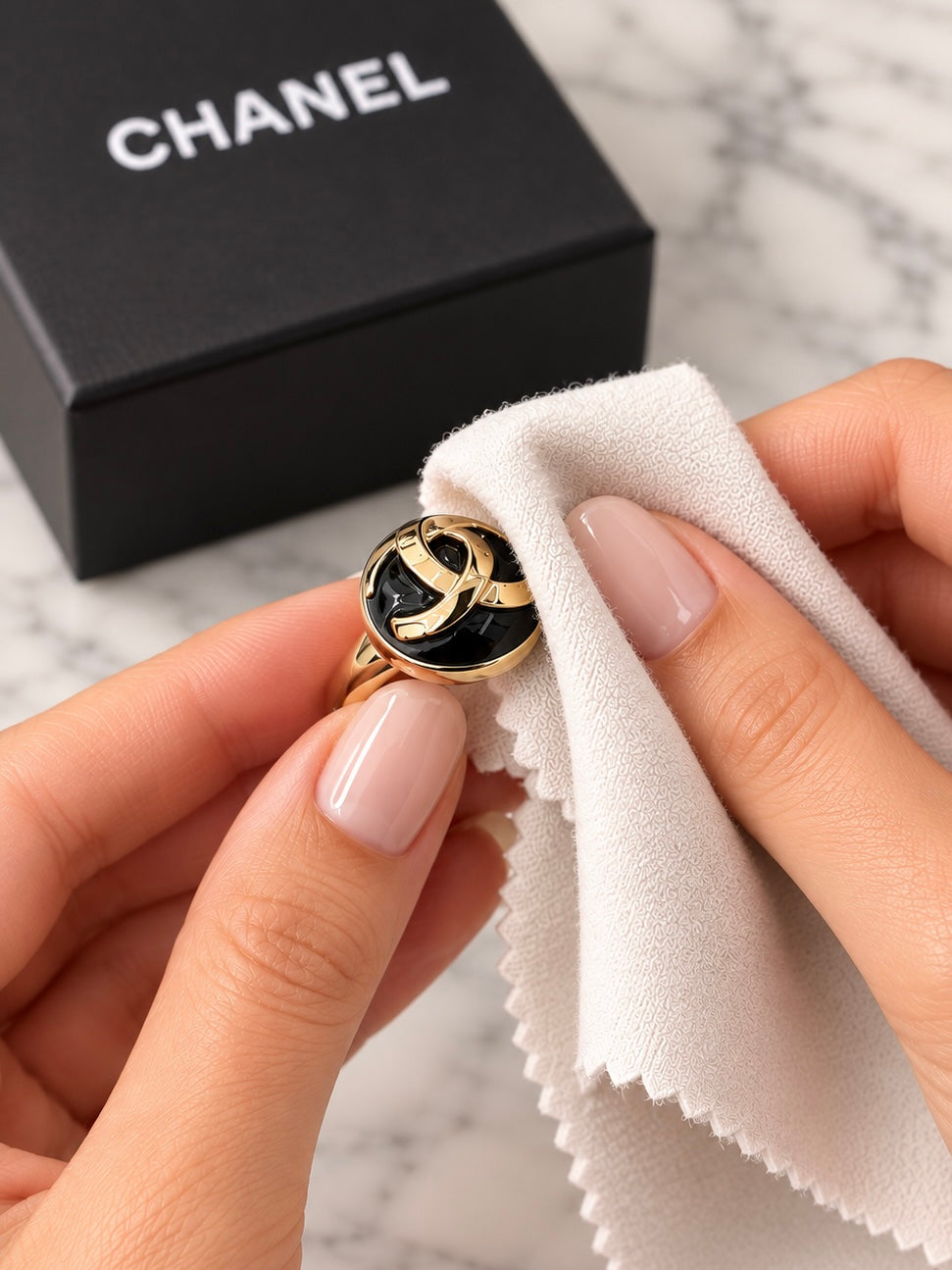
3. Inspect the Quality of the CC Logo
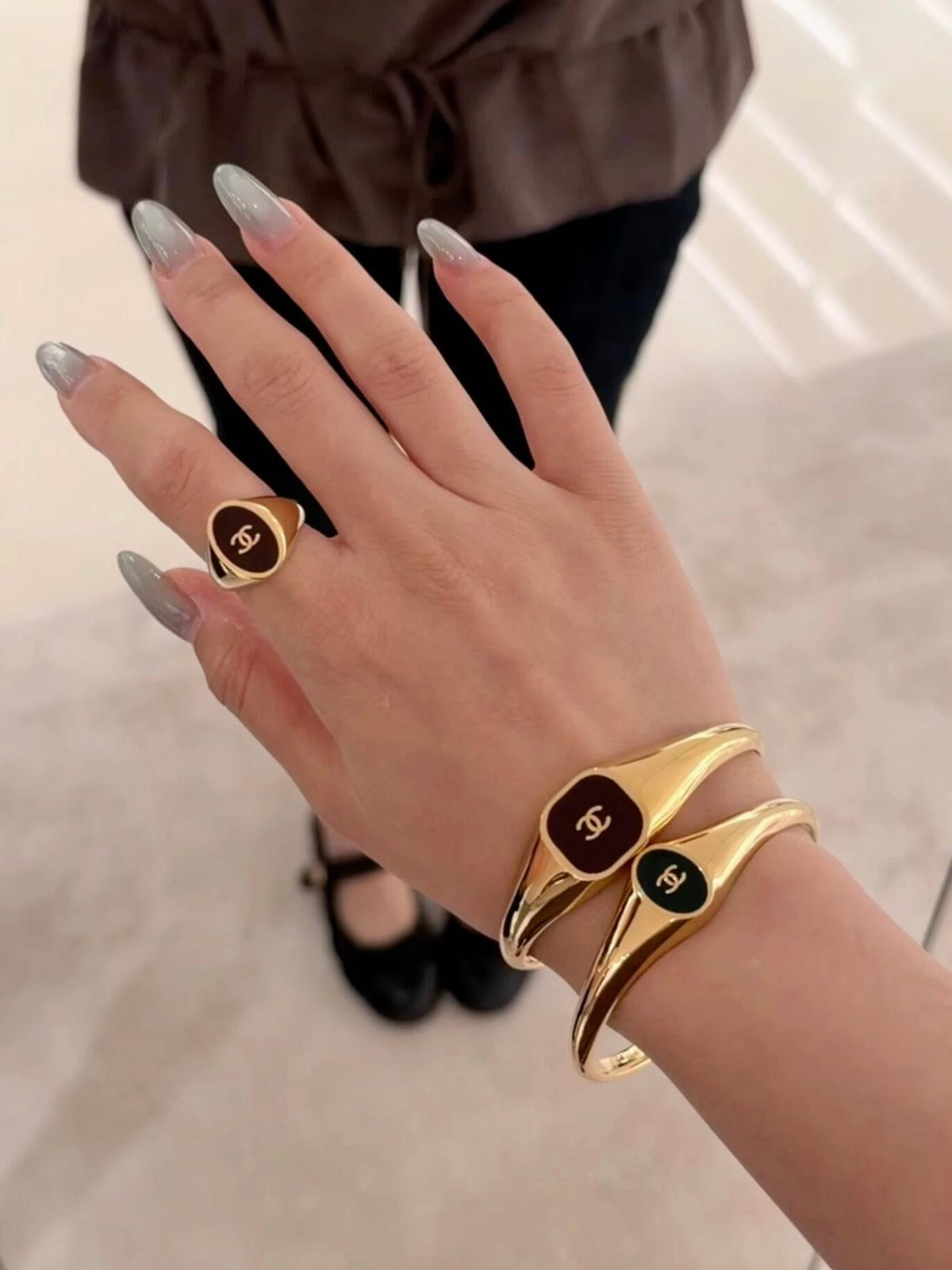
The interlocking CC logo is among the most recognisable features of CHANEL.
It appears across numerous jewellery collections, including earrings, necklaces, bracelets and brooches.
Because the logo is so frequently replicated, it deserves particularly careful examination.
When inspecting the CC emblem, consider:
Shape and proportions
The two interlocking Cs should have shapes and proportions consistent with the particular CHANEL design. Examine their curvature, thickness and overall symmetry.
Interlocking construction
Pay attention to how the two Cs intersect. Their positioning and relationship should be consistent with the original design.
Surface finish
Examine the quality of the finish, including the smoothness of the edges, polish and overall presentation.
Attachment and construction
On earrings, pendants and brooches, inspect how the emblem is attached to the main body of the jewellery. The connection should be consistent with the design and construction of the piece.
No single CC logo characteristic should be treated as definitive proof of authenticity. Different collections and periods can feature variations in construction and finishing.
4. Examine the Metal Finish and Plating
CHANEL costume jewellery is known for its distinctive gold-tone and silver-tone finishes.
Unlike fine jewellery manufactured from solid precious metals, costume jewellery may incorporate base-metal alloys, plated surfaces and other decorative materials.
Authentic pieces can feature a variety of finishes, including:
-
Gold-tone metal.
-
Silver-tone metal.
-
Aged or antique-effect finishes.
-
Two-tone combinations.
-
Textured and brushed metal surfaces.
When assessing the metalwork, look for consistency in the finish and construction.
Examine the jewellery under appropriate lighting, paying particular attention to areas that experience frequent contact or friction.
Look for:
-
Uneven surface finishing.
-
Poorly executed edges.
-
Inconsistent plating.
-
Irregular transitions between materials.
-
Signs of construction that appear inconsistent with the design.
It is important to remember that authentic vintage CHANEL jewellery can exhibit natural ageing, patina, discolouration or plating wear. These characteristics do not automatically indicate that a piece is counterfeit.
Similarly, a perfectly preserved finish does not independently establish authenticity.
5. Assess the Quality of Craftsmanship
Construction and craftsmanship are important elements of a comprehensive authentication assessment.
CHANEL jewellery incorporates a wide range of materials and manufacturing techniques, depending on the collection and design.
Examine the overall construction rather than focusing exclusively on appearance.
Important areas include:
Soldering and joining
Inspect the connections between metal components. Pay attention to the quality of joins, their positioning and whether they are consistent with the intended construction.
Clasps and closures
Examine the functionality, alignment and construction of clasps, hooks and fastening mechanisms.
Earring fittings
For earrings, inspect the posts, clips, hinges, springs and connecting components. Their construction should be appropriate for the particular design.
Chain links
On necklaces and bracelets, examine the individual links, their connections and the consistency of their construction.
Decorative settings
Inspect how crystals, faux pearls, stones and other embellishments are secured.
Counterfeit pieces may display inconsistencies in assembly, finishing or component quality. However, authentic vintage jewellery can also have manufacturing variations and signs of previous repairs.
The assessment must consider the overall construction in context.
6. Inspect Crystals, Faux Pearls and Decorative Elements
CHANEL is renowned for incorporating decorative materials into its jewellery designs.
Depending on the collection, these can include glass crystals, faux pearls, resin, enamel and other embellishments.
These elements should be examined carefully.
Faux pearls
Consider their surface finish, shape, coating and attachment. Examine whether the materials and construction are consistent with the particular design.
Crystals
Inspect the cut, positioning, setting and overall finishing of individual crystals.
Resin and enamel
Examine the quality of the surface, colour consistency and finishing around the edges.
Decorative detailing
Look at the relationship between different materials and how they have been assembled.
It is important not to assume that every authentic CHANEL piece uses identical materials or finishing techniques. Materials and construction vary significantly across collections and production periods.
7. Consider the Weight and Overall Construction
Weight can be another useful observation during an authentication assessment.
Different CHANEL jewellery designs can vary considerably in weight depending on their materials, dimensions and construction.
For example, a large statement necklace may incorporate several decorative components, while a delicate pair of earrings may be considerably lighter.
When examining a piece, consider:
-
Overall weight relative to its dimensions.
-
Distribution of weight.
-
Thickness of metal components.
-
Density and construction of decorative elements.
-
Consistency between individual components.
An unusually lightweight or poorly constructed item may justify further investigation.
However, weight alone should never be used to authenticate or reject a piece. Genuine CHANEL jewellery is produced using different materials and construction methods, meaning there is no universal weight standard.
8. Verify the Provenance and Supporting Documentation
Documentation can provide valuable supporting information when assessing CHANEL jewellery.
Depending on the item's history, available documentation may include:
-
Original purchase receipts.
-
Boutique invoices.
-
Previous ownership records.
-
Original packaging.
-
Historical product information.
-
Other supporting purchase documentation.
Where an original purchase receipt or boutique invoice is available, its details can be compared with the jewellery being examined.
However, packaging, receipts and accompanying documentation should not be treated as conclusive proof of authenticity. Such materials can be separated from their original items or reproduced.
Equally, the absence of original packaging or a receipt does not automatically mean that a piece is counterfeit.
A reliable assessment should establish whether the physical jewellery itself is consistent with the relevant CHANEL design and production characteristics.
9. Why Professional CHANEL Jewellery Authentication Matters
Authenticating luxury jewellery requires more than checking a logo, examining a stamp or comparing photographs online.
Counterfeit production has become increasingly sophisticated, making it important to consider multiple characteristics together.
A comprehensive assessment should examine:
-
Manufacturer markings and inscriptions.
-
Design accuracy and proportions.
-
Metalwork and surface finishing.
-
Construction and assembly.
-
Clasps, fittings and connecting components.
-
Decorative materials and settings.
-
Weight and overall dimensions.
-
Provenance and supporting documentation.
-
Consistency with known examples from the relevant collection and period.
No single characteristic should determine the final conclusion.
At Bijoux Heaven, we recognise the importance of a detailed and methodical authentication process. Our luxury authentication specialists bring over 30 years of combined experience working with prestigious luxury houses, including CHANEL, Hermès, Dior and Louis Vuitton.
Our approach considers the individual characteristics of each item, taking into account its design, materials, construction and relevant production details.
For applicable jewellery, we also utilise specialist examination methods, including microscopic inspection of engravings and XRF testing where appropriate for assessing precious-metal composition.
Our objective is to provide a considered assessment based on the available evidence rather than relying on superficial visual comparisons.
Frequently Asked Questions About CHANEL Jewellery Authentication
Does all authentic CHANEL jewellery have a serial number?
No. CHANEL costume jewellery does not universally feature a serial number. Depending on the design and production period, a piece may feature a manufacturer's stamp, date plate, collection marking or other inscription. The absence of a serial number does not automatically indicate that an item is counterfeit.
Does authentic CHANEL jewellery always say Made in France?
No. Authentic CHANEL jewellery has been produced in different locations, including France and Italy. Markings vary depending on the individual design and production period.
Can you authenticate CHANEL jewellery using photographs?
Photographs can help identify potential inconsistencies and provide an initial assessment. However, they cannot always reveal important details such as engraving depth, construction, material composition and the quality of individual components. Physical examination may be necessary for a more comprehensive assessment.
Is vintage CHANEL jewellery still authentic if it has tarnishing?
Yes. Authentic vintage jewellery can naturally develop tarnishing, patina, plating wear and other signs of ageing. These characteristics should be assessed in the context of the item's age, materials and construction.
Does an original CHANEL box prove authenticity?
No. Original packaging can support an item's provenance, but it does not independently establish authenticity. Packaging can be separated from its original item or reproduced.
Can CHANEL costume jewellery be made from non-precious metals?
Yes. CHANEL costume jewellery commonly incorporates base-metal alloys and plated finishes, alongside decorative materials such as glass, resin, crystals and faux pearls. It should not automatically be assumed to be solid gold or sterling silver.
Confidence Through Knowledge and Expertise
CHANEL jewellery represents decades of design heritage, creativity and craftsmanship. From iconic CC earrings to elaborate vintage necklaces, every collection has its own distinctive characteristics.
Understanding these details is an important first step when purchasing pre-loved luxury jewellery. However, genuine authentication requires a careful assessment of the complete piece, its construction and the characteristics associated with its particular design and production period.
At Bijoux Heaven, we believe that authenticity is fundamental to luxury resale. Every piece deserves careful consideration, and every customer deserves confidence in their purchase.
Explore our collection of pre-loved designer jewellery and discover exceptional pieces from some of the world's most recognised luxury houses.
Bijoux Heaven – Where Timeless Pieces Find New Life.
Visit www.bijouxheaven.com to discover our collection.
Bijoux Heaven is an independent luxury resale business and is not affiliated with, authorised by or endorsed by CHANEL. All brand names and trademarks belong to their respective owners.